
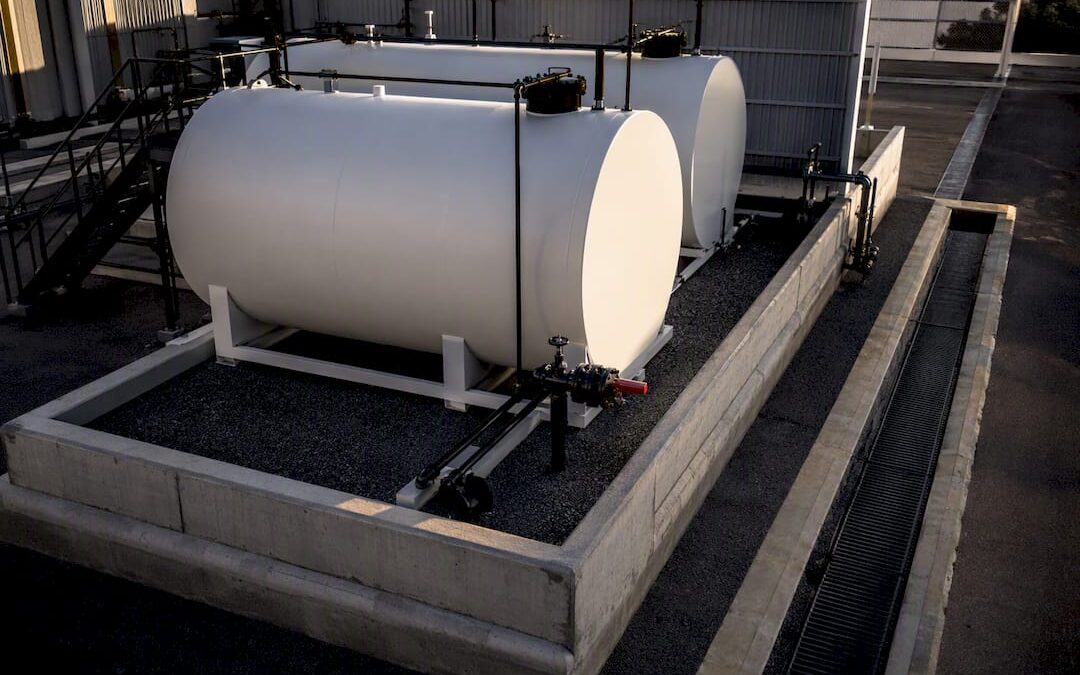
If your site stores more than 1,320 gallons of aboveground fuel or more than 42,000 gallons buried, federal law requires an SPCC Plan. That means secondary containment sized to your largest tank, documented inspections, and a Professional Engineer’s certification unless you qualify for self-certification under EPA criteria. The immediate move: count every container 55 gallons or larger, tally shell capacity, and map where a spill would drain before assuming exemption.
TL;DR:
- Facilities with more than 1,320 gallons of aboveground storage or 42,000 gallons buried must prepare an SPCC Plan that includes secondary containment sized for the largest tank and documented inspections.
- All containers 55 gallons or larger, including drums and mobile units, count toward the threshold, requiring careful capacity calculation and drainage mapping to determine exemption eligibility.
- Buried tanks meeting all underground storage tank requirements are exempt from SPCC but must be clearly documented and marked on facility diagrams.
- Containment must typically hold 110% of the largest tank with proper freeboard, and materials used must be verified as impervious and suitable for spill retention.
- Smaller facilities may self-certify under Tier I or Tier II if meeting specific size and discharge criteria; larger facilities require a professional engineer’s certification.
Table of Contents
- SPCC Fuel Tank Requirements: The Applicability and Counting Rules
- Aboveground vs. Completely Buried Tanks: Exemptions and Documentation
- Secondary Containment and Sizing for Bulk Fuel Tanks
- Transfer Areas, Overfill Prevention, and Active Containment Options
- Inspections, Testing, Recordkeeping, and Plan Maintenance
- Certification Paths: Tier I, Tier II, and PE-Certified Plans
- Practical Compliance Checklist for Facility Managers
- Essential EPA and Regulatory Documents to Download
- Sources
- FAQ
SPCC Fuel Tank Requirements: The Applicability and Counting Rules
SPCC applicability under 40 CFR part 112 comes down to a three-part test. Your facility must be non-transportation-related, store oil above the threshold capacity, and have a reasonable expectation that a discharge could reach navigable waters or an adjoining shoreline. That third part trips up more facilities than the first two combined, since “navigable waters” gets interpreted broadly enough to include storm drains, roadside ditches, and intermittent streams that only run after rain, according to compliance consultants who work SPCC cases regularly.
Counting capacity means using shell capacity, not the amount of fuel actually in the tank, and every container 55 gallons or larger counts toward your total. That includes:
- Bulk aboveground storage tanks (ASTs)
- Drums and totes sitting in a yard or shop
- Mobile refuelers and tank trucks parked onsite
- Certain oil-filled operational equipment, depending on configuration
Permanently closed containers and tanks that meet full underground storage tank (UST) technical requirements don’t count. A yard with three 275-gallon drums and two 500-gallon ASTs adds up to 1,825 gallons of shell capacity, which clears the 1,320-gallon aboveground threshold even though no single tank looks impressive on its own. Our breakdown of the 1,320-gallon trigger walks through more yard-tank scenarios if your inventory sits close to the line.
Aboveground vs. Completely Buried Tanks: Exemptions and Documentation
Not every buried tank gets a free pass. A tank has to be completely buried and meet every technical requirement of the UST program under 40 CFR part 280 or an approved state program to qualify for the SPCC exemption. Partially buried tanks or those in vaults or bunkers are not exempt and are regulated as aboveground tanks because spill behavior resembles surface release.
Exempt buried tanks still must be clearly marked on facility diagrams per EPA requirements; omission is a common inspection finding.
A clean documentation approach looks like this:
- Mark every buried tank on the facility diagram, exempt or not.
- Note the UST program citation or state approval that supports the exemption.
- Flag partially buried or bunkered tanks separately since they carry full SPCC obligations.
Secondary Containment and Sizing for Bulk Fuel Tanks
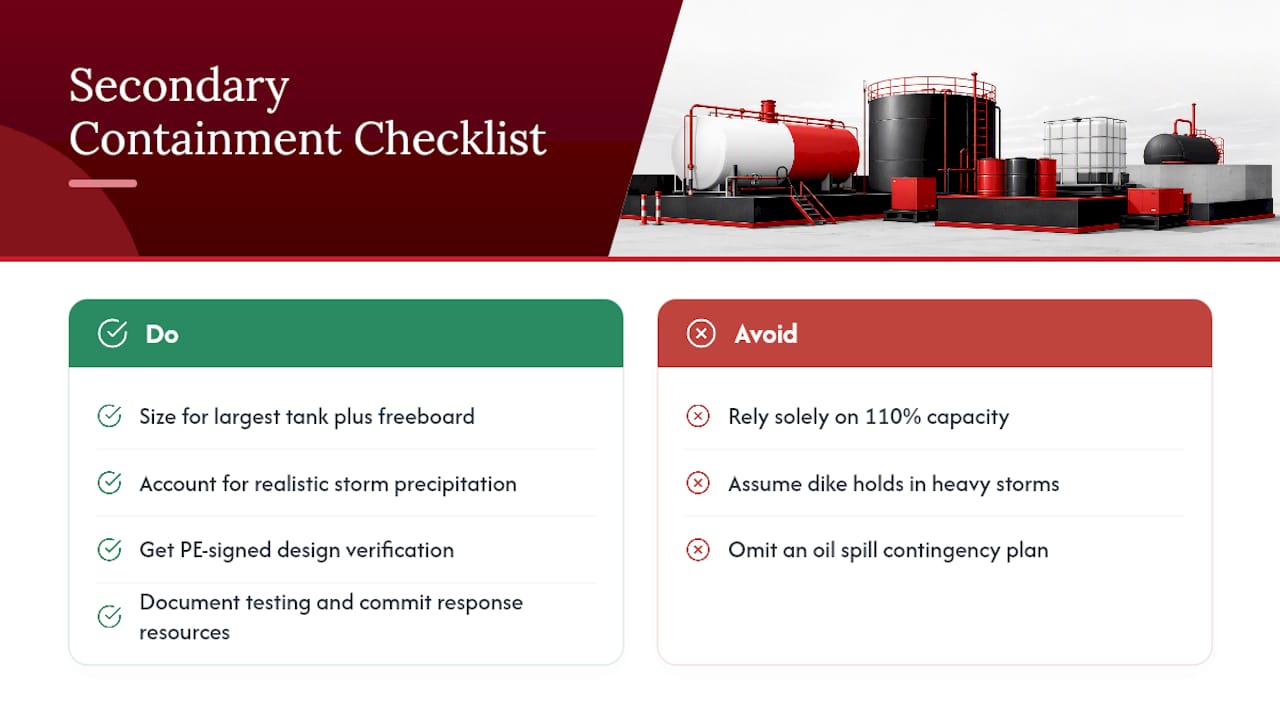
Containment must be sized to hold the volume of the largest single container plus sufficient freeboard for precipitation, as per regulatory expectations.
EPA guidance for regional inspectors treats 110% of tank capacity as a common rule of thumb, but the agency is explicit that 110% isn’t automatically sufficient. A dike sized at 110% capacity may overflow during heavy precipitation events depending on regional weather, which inspectors examine carefully.
Statistic Callout: The regulatory anchor point that matters most: containment sized only for the largest container, without freeboard for a realistic storm event, fails the “sufficient” standard even at 110% capacity in high-precipitation regions.
“Sufficiently impervious” containment means the material, whether it’s concrete, steel, or a lined earthen berm, has to actually hold liquid for the duration of a response. Verifying that isn’t a guess. A PE who signs your Plan is attesting the containment design and its imperviousness meet good engineering practice for your specific site, which carries real legal weight if a spill ever gets investigated.
Pro Tip: If sized containment is genuinely impracticable, document exactly why in writing, run integrity testing on the tank and piping, and commit specific manpower, equipment, and materials to spill response in your Plan. An oil spill contingency plan becomes mandatory once you take this route, not optional paperwork.
Transfer Areas, Overfill Prevention, and Active Containment Options
Loading racks, transfer areas, and mobile refuelers don’t always need sized containment the way bulk tanks do. EPA distinguishes between general containment, built around good engineering practice, and specific containment, which is dimensioned and sized like a bulk tank dike. Transfer areas tied to exempt USTs often fall under the general standard, but only if the Plan documents the reasoning.
Active containment measures are acceptable substitutes when documented properly:
- Pre-positioned sorbent pads and drip pans at transfer points
- Curbing that directs spilled fuel away from drainage paths
- Rapid-response kits with assigned personnel and training records
Overfill prevention rounds out this section, and it’s where a lot of avoidable incidents happen. High-level alarms, automatic shutoffs, audible vents, and written transfer procedures belong in the Plan itself, not just in a driver’s head. Our guide on temporary fuel tank regulations covers how mobile and portable tanks fit into this same framework.
Inspections, Testing, Recordkeeping, and Plan Maintenance
An SPCC Plan that sits in a drawer doesn’t protect you during an inspection. EPA expects an active maintenance rhythm:
- Conduct routine visual inspections of tanks, piping, and valves on a documented schedule.
- Run integrity testing on buried piping whenever it’s installed or repaired, plus periodic testing on aboveground systems per the Plan’s schedule.
- Retain records onsite, including inspection logs, integrity test reports, the facility diagram, current inventory, contingency plans, and staff training records.
- Keep the Plan at the facility if the site is attended four or more hours a day.
- Review the Plan every five years, or sooner after any material change like a new tank, a containment redesign, or a change in throughput.
That five-year clock resets faster than most managers expect. Adding a single new AST, swapping out piping, or reconfiguring a transfer area all count as material changes that trigger an earlier review, and inspectors specifically look for Plans that were never updated after equipment changes.
Certification Paths: Tier I, Tier II, and PE-Certified Plans
Not every facility needs an engineer’s signature. If your aggregate aboveground storage is 10,000 gallons or less and no single container exceeds 5,000 gallons, with no significant recent discharge history, you likely qualify as a Tier I facility. That status lets you self-certify using EPA’s Appendix G template instead of hiring a PE.
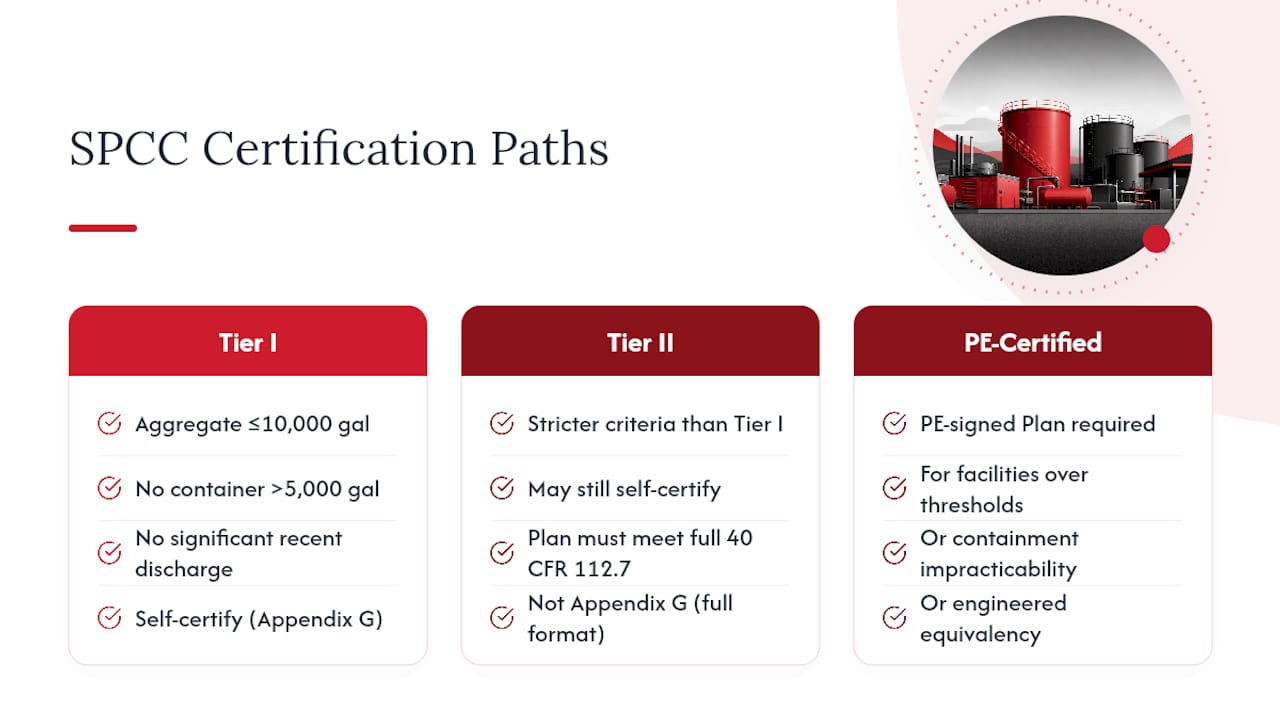
Tier II facilities also self-certify, but the criteria are stricter, and the Plan still has to address every applicable technical requirement under 40 CFR 112.7 in full, not the abbreviated Tier I format.
Everyone else needs a PE-certified Plan. That includes facilities above the Tier I/II thresholds, any facility requesting a containment impracticability determination, and any site using an engineered equivalency instead of standard containment. The PE’s signature isn’t a formality. It’s a professional attestation that carries legal exposure if the design fails during an actual spill.
Practical Compliance Checklist for Facility Managers
Getting audit-ready isn’t complicated, but skipping a step here is what gets facilities cited. Work through it in order:
- Inventory everything. Count shell capacity across all containers, list every one 55 gallons or larger, and flag mobile refuelers or tank trucks that park onsite regularly.
- Map your drainage. Trace where a spill would travel, including storm drains and roadside ditches that connect to navigable waters, per EPA’s broad interpretation.
- Calculate containment. Size dikes and berms to the largest single container plus freeboard, or document in writing why sized containment is impracticable.
- Choose your certification route. Confirm whether you qualify for Tier I or Tier II self-certification, or arrange PE certification if you don’t.
- Lock in operations. Schedule inspections, store records onsite, and calendar your five-year Plan review now so it doesn’t slip.
Pro Tip: Run this checklist annually even if nothing on your site has changed. Inspectors don’t accept “we didn’t think it counted as a material change” as an answer, and a fresh annual pass catches drift before it becomes a citation. A reliable bulk fuel delivery partner can also help you keep tank levels and delivery records consistent with what your Plan documents.
Essential EPA and Regulatory Documents to Download
Bookmark these before your next inspection, not during it:
- The SPCC rule itself under 40 CFR part 112, the foundation for every requirement above.
- The Tier I Qualified Facility Appendix G template, if your storage qualifies for self-certification.
- EPA’s underground storage tank guidance for SPCC Plans, for facilities with buried tanks needing exemption documentation.
- The secondary containment and impracticability guidance for regional inspectors, which explains exactly what inspectors look for on containment sizing.
Running fuel logistics on a job site, at a data center, or across a municipal fleet gets harder when your storage setup and your delivery schedule aren’t talking to each other. Anytimefuelpros works with facility managers across Texas, Utah, and nationwide through its partner network to keep diesel fuel delivery predictable, which makes it easier to plan tank levels around your containment capacity instead of guessing. If you’re weighing bulk tank fills against scheduled deliveries as part of your SPCC strategy, our team can walk through fuel delivery options that fit your site’s storage limits and compliance timeline. Fleet operators coordinating transfer procedures across multiple vehicles may also want to review vetted fleet service resources for handling fuel-adjacent maintenance work safely.
This article is general information, not a substitute for advice from a qualified lawyer. Consult a qualified legal professional about your own circumstances before acting on anything here.
Sources
- Spill Prevention, Control, and Countermeasure (SPCC) for the Upstream Sector | U.S. EPA
- Tier I Qualified Facility SPCC Plan Template | U.S. EPA
- Underground Storage Tanks in SPCC Plans | U.S. EPA
- SPCC Guidance for Regional Inspectors (Secondary containment and impracticability) | U.S. EPA
FAQ
How Many Gallons Require an SPCC Plan?
You need an SPCC Plan once your facility’s aggregate aboveground oil storage exceeds 1,320 gallons, counting every container 55 gallons or larger, or once completely buried storage exceeds 42,000 gallons, provided a discharge could reasonably reach navigable waters.
What Are the Core SPCC Rule Requirements?
The rule requires a site-specific written Plan, secondary containment sized for the largest container plus freeboard, documented inspections and integrity testing, a facility diagram, and either self-certification for qualified facilities or PE certification for everyone else.
How Far Should a Fuel Storage Tank Be From a Building?
SPCC itself doesn’t set a fixed tank-to-building distance; that spacing typically comes from local fire codes and National Fire Protection Association standards, so check with your fire marshal alongside your SPCC containment planning.
What Certification Do Aboveground Fuel Tanks Need Under SPCC?
Facilities with 10,000 gallons or less aboveground and no container over 5,000 gallons can often self-certify as a Tier I qualified facility using EPA’s Appendix G template; larger or higher-risk facilities need a PE-certified Plan.
Recent Comments