

The off-road diesel procurement process is a structured method that guides companies through sourcing, contracting, delivery, and compliance management of dyed diesel fuel used exclusively off public roads. Procurement professionals managing heavy equipment fleets, mining operations, or construction sites need more than a supplier phone number. They need a repeatable system that covers volume planning, supplier verification, contract negotiation, bulk diesel delivery logistics, and documentation that survives a tax audit. This guide walks through every stage of that system, with specific tools, contract structures, and compliance requirements for 2026.
What is the off-road diesel procurement process?
The off-road diesel procurement process, known in the industry as dyed diesel fuel sourcing or bulk fuel procurement, covers every decision from specification to delivery receipt. The full process includes defining volume and technical specifications, verifying supplier legitimacy, negotiating price and contract terms, managing logistics, and maintaining compliance documentation. Each stage depends on the one before it. Skipping supplier verification, for example, puts your pricing leverage and supply reliability at risk before the first gallon moves.
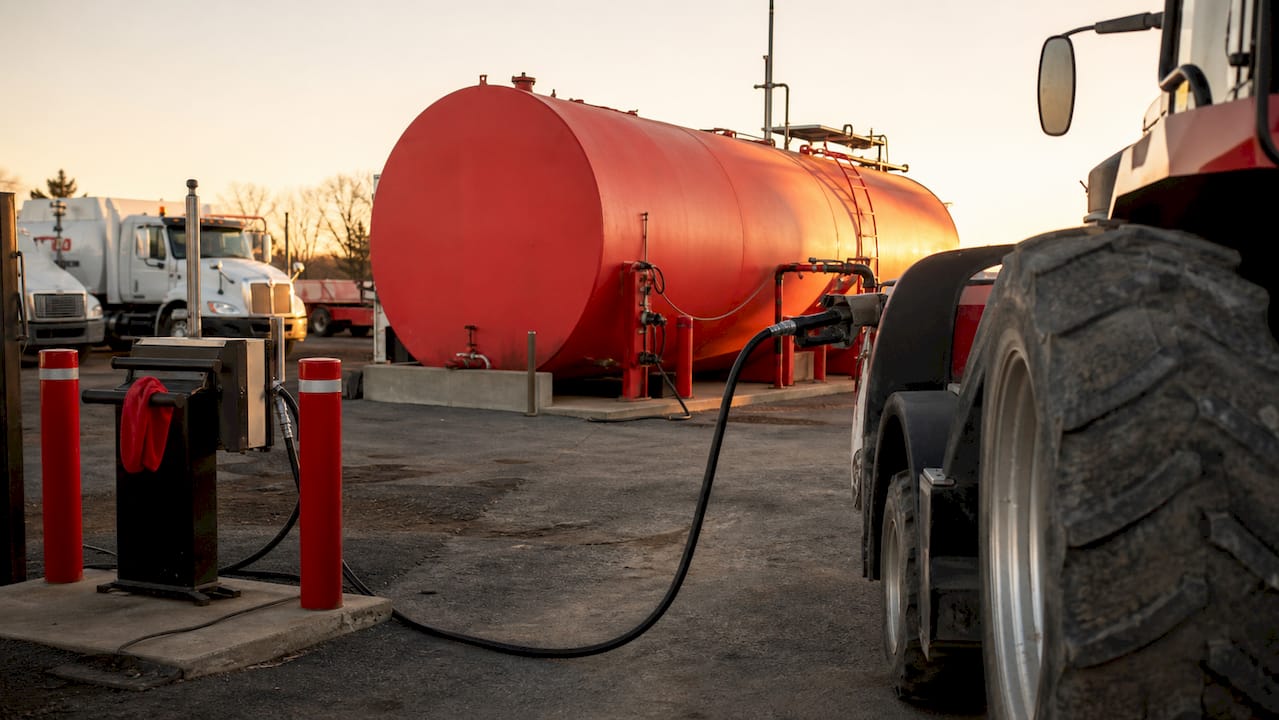
Off-road diesel, also called dyed diesel or red diesel, is chemically identical to on-road diesel but carries a red dye marker that signals its tax-exempt status for non-road use. Understanding the difference between on-road and off-road diesel is the foundation of compliant purchasing. Using it in licensed highway vehicles is a federal offense with penalties that far exceed any tax savings.
What prerequisites do you need before buying off-road diesel?
Preparation separates procurement teams that close favorable contracts from those that scramble to meet supplier requirements at the last minute. Before you contact a single supplier, you need four things in order: volume estimates, technical specifications, legal documentation, and the right procurement tools.
Volume estimation and fuel specifications
Start with a 90-day consumption forecast based on equipment hours, job site count, and seasonal demand. Specify the fuel’s required cetane number, sulfur content, and lubricity rating. These parameters determine whether the fuel is compatible with your OEM equipment warranties. A Certificate of Analysis for every batch is the only reliable way to verify that delivered fuel meets those specs. Never assume standard quality without written verification.
Documentation and supplier verification requirements
Reputable suppliers require buyers to submit a documentation package before any pricing discussion. That package typically includes:
- Corporate registration and business license
- Federal tax ID and state fuel tax exemption certificate
- End-user certificate or declaration of intended use
- Proof of funds or credit reference for large-volume orders
- Letter of Authorization (LOA) if purchasing through a broker or agent
Buyers who arrive with complete documentation gain access to better pricing and faster contract execution. Incomplete files signal risk to the supplier and result in delayed quotes or rejected applications.
Procurement tools that simplify the process
Three categories of tools matter here. Online procurement portals from suppliers like Pilot Flying J or regional distributors allow volume ordering and delivery scheduling in one place. Fuel cards from networks such as WEX or Comdata track purchases by driver, vehicle, and location, which simplifies compliance reporting. Compliance tracking software, including platforms like Fleetio or custom ERP modules, centralizes usage logs and purchase records so your team is never scrambling before an audit.
| Tool Category | Example Options | Primary Benefit |
|---|---|---|
| Online procurement portals | Supplier-direct platforms, regional distributor portals | Centralized ordering and delivery scheduling |
| Fuel cards | WEX, Comdata, cardlock networks | Per-driver, per-vehicle purchase tracking |
| Compliance software | Fleetio, ERP fuel modules | Automated usage logs and audit-ready records |
How to execute the diesel purchasing process step by step
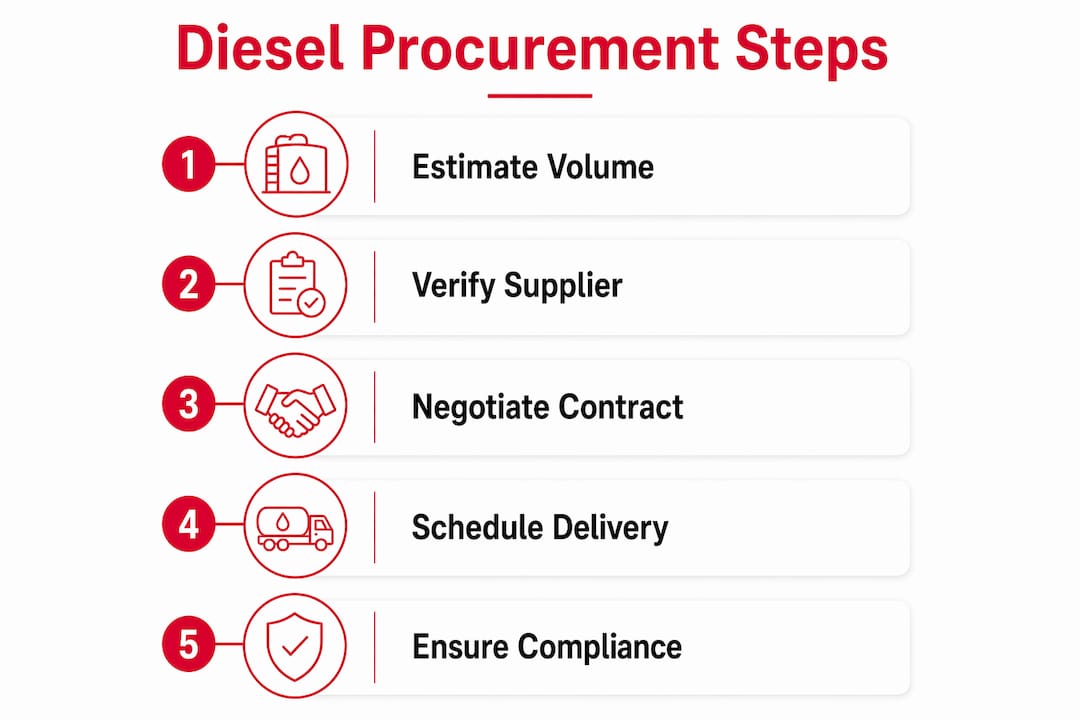
With prerequisites in place, the actual diesel purchasing process follows a clear sequence. Each step builds on documented decisions from the step before it.
-
Issue a Request for Proposal (RFP). Send your volume forecast, fuel specifications, delivery location, and required documentation to at least three pre-vetted suppliers. Specify whether you need term pricing, spot pricing, or a hybrid arrangement.
-
Evaluate supplier proposals against your spec sheet. Compare pricing formulas, delivery lead times, minimum order quantities, and quality assurance procedures. Do not select on price alone. A supplier who cannot provide a Certificate of Analysis on demand is a compliance liability.
-
Negotiate contract terms. Bulk fuel contracts come in three structures: term contracts with pre-agreed pricing formulas, spot contracts for one-time purchases, and hybrid contracts that combine both. Term contracts provide supply certainty. Hybrid contracts add flexibility for volume swings. Negotiate pricing tied to Platts or Argus indices with a fixed premium or discount, not arbitrary flat rates that leave you exposed to margin manipulation.
-
Clarify delivery terms. FOB (Free on Board) pricing means you control the fuel once it leaves the supplier’s terminal and bear the transport cost and risk. CIF (Cost, Insurance, and Freight) pricing means the supplier delivers to your site and absorbs transport risk. FOB typically costs less per gallon but requires you to arrange your own bulk fuel delivery logistics.
-
Request and review the Certificate of Analysis before each delivery. Verify cetane number, sulfur content, and lubricity against your equipment OEM specs. Reject any batch that falls outside tolerance.
-
Confirm compliance documentation at point of delivery. The delivery invoice must show the supplier’s license number, the dyed diesel designation, the delivery address, and the quantity in gallons. File this immediately.
Pro Tip: Request a sample contract from your supplier before negotiations begin. Review the dispute resolution clause specifically. Clear contract terms that address fuel quality disagreements and delivery penalties protect you from costly disputes that drag on for months.
| Contract Type | Best For | Key Trade-Off |
|---|---|---|
| Term contract | Predictable, high-volume operations | Less price flexibility during market dips |
| Spot contract | One-time or variable-volume needs | Higher per-gallon cost, no supply guarantee |
| Hybrid contract | Operations with seasonal volume swings | Requires active management of both contract types |
What are the compliance and recordkeeping requirements?
Compliance in off-road diesel purchasing is not optional, and the penalties for poor recordkeeping are significant. The IRS and state fuel tax authorities conduct audits, and the burden of proof falls entirely on the buyer.
Businesses must retain purchase and usage records for at least three years to demonstrate proper off-road use during an audit. That three-year window means a purchase made today must be documentable in 2029. Required records include:
- Receipts from licensed suppliers showing dyed diesel designation
- Delivery invoices with supplier license number, quantity, and delivery address
- Equipment usage logs linking fuel consumption to specific machines and job sites
- Fuel tax exemption certificates on file for each purchase period
The most common audit trigger is a gap between purchased volume and documented equipment usage. If you bought 50,000 gallons but your usage logs only account for 35,000, the IRS assumes the difference went into taxable on-road vehicles. That assumption carries back taxes, penalties, and interest.
The single most effective compliance practice is real-time documentation. Log every delivery and every equipment fill at the time it happens, not at month-end. Retroactive recordkeeping creates inconsistencies that auditors flag immediately.
Fuel cards solve a large part of this problem by generating automatic purchase records tied to specific vehicles and drivers. Many cardlock networks also require buyers to certify intended use at the point of purchase, which creates a contemporaneous compliance record. Pair fuel cards with a digital usage log in Fleetio or a similar platform, and your audit preparation time drops from days to hours.
Pro Tip: Assign one person on your procurement team as the compliance owner. That person is responsible for filing every delivery invoice within 24 hours of receipt and reconciling fuel card data against usage logs weekly. Integrated recordkeeping systems are only effective when someone owns the process.
What logistics approaches optimize bulk diesel delivery?
Efficient off-road fuel sourcing depends as much on logistics as it does on contract terms. A favorable price means nothing if fuel does not arrive when and where your equipment needs it.
Three delivery models serve most operations:
- Direct bulk delivery to onsite tanks. A tanker truck delivers to your fixed storage tank on a scheduled basis. This model works well for permanent job sites, equipment yards, and mining operations with predictable daily consumption.
- Mobile wet-hosing. Wet-hosing is a delivery method where a tanker truck refuels equipment directly at the machine, eliminating the need to move heavy equipment to a fuel point. Licensed distributors providing wet-hosing also supply the delivery documentation required for compliance. This model is ideal for large construction sites with multiple pieces of heavy equipment spread across a wide area.
- Cardlock station refueling. Drivers or operators use fuel cards at certified cardlock stations. This model suits smaller fleets or operations near established cardlock networks, but it requires equipment to travel to the fuel point, which adds machine hours and wear.
Scheduled bulk deliveries and route optimization reduce operational downtime and control costs for remote job sites. The key is coordinating delivery schedules with your operations calendar so fuel arrives before tanks drop below a 20% reserve level. Running equipment to empty on a remote site is a production stoppage that costs far more than the fuel itself.
Storage safety is a separate but related concern. Onsite tanks must meet EPA and state secondary containment requirements. Contamination from water intrusion or incompatible residue in storage tanks degrades fuel quality and damages injection systems. Inspect tanks before each fill and use fuel polishing services if stored diesel has been sitting for more than 90 days.
| Delivery Model | Best Application | Key Consideration |
|---|---|---|
| Bulk tank delivery | Fixed sites, high daily volume | Requires compliant onsite storage |
| Mobile wet-hosing | Large sites, dispersed equipment | Higher per-gallon cost, maximum convenience |
| Cardlock station | Small fleets, urban operations | Equipment must travel to fuel point |
How do contract structuring and pricing strategies control costs?
Contract structure is where procurement professionals either protect their budget or expose it to unnecessary risk. The pricing formula in your contract determines whether you benefit from falling market prices or absorb the full impact of spikes.
Pricing tied to Platts or Argus indices with a negotiated premium gives you market transparency. You know exactly how your price is calculated each day. Flat-rate contracts that do not reference a published index give the supplier pricing discretion, which rarely benefits the buyer over a multi-month term.
Key contract elements to negotiate before signing:
- Volume commitments and rollover clauses. Commit to a volume range, not a fixed number. Rollover clauses allow unused volume from one period to carry into the next without penalty.
- Price adjustment triggers. Define the conditions under which either party can request a price renegotiation. Market disruptions, regulatory changes, and force majeure events should all be addressed explicitly.
- Credit terms and payment scheduling. Net-30 payment terms are standard for established buyers. First-time buyers often face security deposit requirements for initial shipments. Negotiate to reduce or eliminate deposits after a defined track record of on-time payment.
- Dispute resolution procedures. Specify whether disputes go to arbitration or litigation, and in which jurisdiction. Arbitration is faster and less expensive for fuel quality disagreements.
Advanced buyers implement hybrid contracts that combine term commitments for baseline volume with spot purchases for peak demand. This approach balances supply certainty with price flexibility. When spot prices fall below your term rate, you buy additional volume at spot. When spot prices spike, your term contract protects your baseline supply at the agreed formula price.
Pro Tip: Always negotiate a fuel quality rejection clause. If a delivered batch fails your Certificate of Analysis review, the contract should require the supplier to replace the batch at no additional cost within a defined timeframe. Without this clause, you bear the cost of off-spec fuel and the downtime it causes.
Anytimefuelpros: reliable off-road diesel delivery for your operation
Executing a compliant, cost-controlled fuel procurement program requires a delivery partner who understands both the logistics and the documentation requirements. Anytimefuelpros delivers on-site dyed diesel directly to job sites, equipment yards, mining operations, and construction fleets across Texas, Utah, and nationwide through a trusted partner network.
Whether you need scheduled bulk fuel delivery to a fixed onsite tank or mobile wet-hosing across a large construction site, Anytimefuelpros provides transparent invoicing, compliant delivery documentation, and 24/7 emergency response. For procurement teams managing multi-site operations or navigating their first large-scale dyed diesel contract, the diesel fuel delivery service is built to handle the complexity so your equipment keeps running. Visit the fuel delivery questions page to get answers specific to your operation before your next order.
FAQ
What is off-road diesel and why does it require a separate procurement process?
Off-road diesel is dyed diesel fuel designated for non-road equipment use and exempt from federal and state road taxes. It requires a separate procurement process because buyers must document intended use, maintain compliance records, and work with licensed distributors to avoid tax penalties.
How long must off-road diesel purchase records be retained?
Businesses must keep purchase and usage records for at least three years. Required documents include licensed supplier receipts, delivery invoices, and equipment usage logs.
What is the difference between FOB and CIF pricing in a diesel contract?
FOB pricing transfers ownership and transport risk to the buyer at the supplier’s terminal, typically at a lower per-gallon cost. CIF pricing includes delivery to your site with the supplier bearing transport risk, which is more convenient but priced higher.
What is wet-hosing and when should procurement teams use it?
Wet-hosing is a mobile delivery method where a tanker truck refuels equipment directly onsite without moving the machinery. It is the most efficient option for large construction or mining sites with dispersed heavy equipment.
How do hybrid contracts reduce risk in off-road diesel purchasing?
Hybrid contracts combine a term commitment for baseline volume with spot purchases for variable demand. This structure protects supply certainty while allowing buyers to capture lower spot prices when market conditions favor it.
Key takeaways
A compliant, cost-controlled off-road diesel procurement process requires documented volume planning, verified suppliers, structured contracts with index-linked pricing, and real-time recordkeeping maintained for a minimum of three years.
| Point | Details |
|---|---|
| Document before you buy | Prepare corporate registration, tax IDs, end-user certificates, and proof of funds before contacting suppliers. |
| Verify fuel quality on every batch | Request a Certificate of Analysis for each delivery to confirm cetane number, sulfur content, and lubricity. |
| Use hybrid contracts for flexibility | Combine term and spot purchasing to protect baseline supply while capturing favorable spot market prices. |
| Retain records for three years | Keep supplier receipts, delivery invoices, and equipment usage logs to survive a fuel tax audit. |
| Match delivery model to site type | Use bulk tank delivery for fixed sites, wet-hosing for dispersed equipment, and cardlock for smaller urban fleets. |
Recent Comments