
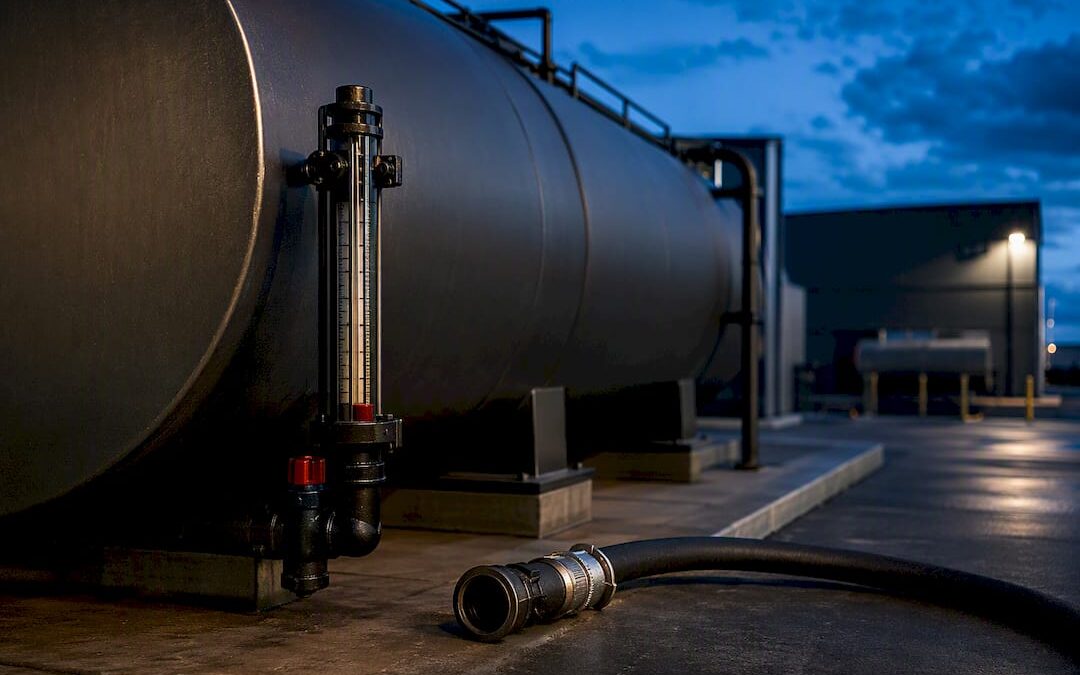
A minimum fuel delivery is the smallest amount a supplier will pump on a single visit, usually somewhere between 100 and 1,000 gallons for standard commercial drops, 25 to 500 gallons for small wet-hose jobs, and 4,000 to 6,500 gallons or more for a full tanker lift. Check your supplier’s stated minimum against your tank’s usable capacity and your daily burn rate before you call. That comparison tells you whether to order now, wait, or find another route to get fuel on-site.
TL;DR:
- Small wet-hose deliveries can range from 25 to 500 gallons, often at higher per-gallon rates below 100 gallons, while full tanker lifts carry over 4,000 gallons due to tank capacity.
- Minimum order sizes are influenced by route economics, truck capacity, site constraints, fuel type, and seasonal demand, requiring negotiation for better terms or volume commitments.
- Calculating your reorder point involves measuring usable tank volume, assessing daily consumption, and adding lead time and safety buffers to determine the appropriate minimum order.
- If your needs fall below the supplier’s minimum, options include renting temporary tanks, consolidating orders across sites, or sharing loads via partner networks.
- Small deliveries generate higher emissions and risk fuel degradation, so consolidating orders and matching volume to realistic coverage periods improve both environmental impact and storage stability.
Table of Contents
- Typical Minimum Fuel Delivery Quantities by Method
- What Determines a Supplier’s Minimum Order?
- How Do You Calculate Your Site’s Minimum Order?
- What If You Need Less Than the Supplier Minimum?
- How Do You Negotiate Fuel Delivery Minimums?
- Operational Checklist Before You Place an Order
- Spill Prevention and Storage Compliance for Small Deliveries
- Does Fuel Type Change Your Minimum Delivery Quantity?
- Do Small Fuel Deliveries Have a Bigger Environmental Footprint?
- How Anytime Fuel Pros Handles Minimums and Uptime
- Sources
- FAQ
Typical Minimum Fuel Delivery Quantities by Method
The number you get quoted depends almost entirely on how the fuel reaches your tank, not just who you call. Wet-hose and small commercial drops sit at the low end. Suppliers in this tier commonly prefer orders of 100 gallons or more, though some will go as low as 25 gallons when the route and schedule allow it, typically at a higher per-gallon cost than a standard drop.
Bulk tanker lifts sit at the other end of the spectrum. A full truckload tanker typically carries 4,000 to 6,500 gallons depending on tank type and DOT weight limits, which is why a straight tanker order almost always implies a high minimum. Terminal and refinery purchases fall somewhere in between on flexibility but often demand the largest volume commitments of all, trading a higher minimum for tighter, clearer pricing.
- Wet-hose/small drop: 25–500 gallons, higher per-gallon rate below 100 gallons
- Standard commercial delivery: 100–1,000 gallons, the most common range for job sites and fleets
- Full tanker lift: 4,000–6,500+ gallons, driven by DOT-spec tank capacity
- Refinery-direct purchase: highest minimums, offset by more predictable pricing formulas
What Determines a Supplier’s Minimum Order?
A supplier’s minimum is not an arbitrary number. It is built from five cost and risk variables, and understanding each one gives you real leverage when you negotiate.
Route economics drive most of it. A driver’s time, fuel, and truck wear cost roughly the same whether the drop is 50 gallons or 5,000, so suppliers set minimums that make the trip worth dispatching. Truck capacity and DOT specifications also matter. Tank types like MC 307, 312, 331, and 338 each carry different maximum volumes, and a supplier running larger MC 331 trailers will naturally push for bigger orders per stop.
Site access and safety add another layer. Tight yards, overhead obstructions, or missing offload permits can push a supplier toward larger, less frequent drops just to justify the setup time. Fuel-type compliance matters too. Dyed (off-road) diesel carries different documentation requirements than clear diesel, and that paperwork burden sometimes gets folded into the minimum. Finally, seasonal demand shifts everything. Winter heating season and harvest season both tighten driver availability and lead times.
- Route economics and driver time per stop
- Truck and DOT tank-spec capacity constraints
- Site access, permits, and offload safety equipment
- Dyed versus clear diesel documentation requirements
- Seasonal demand and lead-time variability
Pro Tip: Ask your supplier which tank-spec truck services your route. A yard that can only accommodate a smaller MC 307 tanker will almost always have a lower minimum than one running full MC 331 trailers, simply because the truck itself carries less.
How Do You Calculate Your Site’s Minimum Order?
Setting your own reorder point takes four numbers most facilities teams already have on hand: usable tank capacity, average daily consumption, supplier lead time, and a safety buffer. Here is the sequence.
- Measure usable tank volume. Subtract the unusable bottom heel and any required freeboard from your tank’s rated capacity to get gallons you can actually draw down.
- Calculate average daily usage. Pull consumption from generator run-hours, fleet fuel logs, or equipment burn rates over a representative period, not just one busy week.
- Set your desired days of coverage. Most sites target 7 to 14 days of runway; mission-critical operations like data centers often push higher.
- Add supplier lead time plus a buffer. Fleet management guidance recommends building your reorder point from lead time and an added safety margin, not just raw consumption.
- Translate into a minimum order. Multiply your desired days of coverage by daily usage, then check that figure against your supplier’s stated minimum.
Here is a quick example: a site burns 150 gallons a day, the supplier’s lead time is 3 days, and the target coverage is 10 days. That means your reorder point sits at 450 gallons (3 days lead time × 150 gallons), and your order size should cover the full 10-day window, or 1,500 gallons.
That math only holds if your inventory numbers are accurate. Fuel expands and contracts with temperature, and density shifts can throw off level-based readings if you are not reconciling deliveries against actual draw-down. Reconcile your tank gauge against delivery tickets weekly, not just at month-end, to catch discrepancies before they turn into a surprise stockout.
What If You Need Less Than the Supplier Minimum?
Falling short of a supplier’s threshold does not mean you are stuck paying a premium forever. Several practical routes exist, and most facilities teams end up combining two or three of them.
Short-term tank rental is often the cleanest fix. Renting a temporary aboveground storage tank lets you consolidate several small needs into one qualifying order, then draw down over weeks instead of calling for repeat small drops. Consolidating orders across nearby sites works the same way. If your company runs two job sites ten minutes apart, scheduling both on the same truck run often clears the minimum without either site ordering more fuel than it needs.
Partner networks and load-sharing arrangements are worth asking about directly. Some suppliers can combine your small order with a nearby customer’s delivery on the same route, effectively splitting the minimum between two accounts. And sometimes the math simply favors accepting the higher per-gallon rate. If a small drop costs an extra $0.15 to $0.30 a gallon but saves a crew from a half-day trip to a retail station, the premium usually pays for itself.
- Rent a temporary tank to consolidate multiple small needs into one order
- Coordinate delivery schedules across nearby sites on the same route
- Ask about partner-network load-sharing to split a minimum
- Weigh the small-order premium against labor and downtime costs
- Confirm permitting and insurance coverage before setting up wet-hose or yard fueling
How Do You Negotiate Fuel Delivery Minimums?
Minimums are rarely fixed once a supplier relationship is underway. Most are negotiated in the same conversation as pricing, so treat them together instead of accepting whatever the first quote states.
Volume commitments are the biggest lever. Committing to a set number of gallons across a quarter or a year, rather than negotiating drop by drop, often gets you a lower per-drop minimum and better pricing. One supplier evaluation framework suggests trading a modest increase in committed annual volume for guaranteed lead times and lower per-drop fees, which usually beats chasing the cheapest spot price site by site.
Service-level terms deserve equal attention. Lock in a lead-time guarantee and an emergency response window in writing, not as a verbal assurance. Watch for fees that erode any minimum you negotiate: short-drop charges, after-hours surcharges, tank cleaning fees, and cancellation penalties can all add up faster than the base price. Pricing formulas matter too. Daily-indexed pricing and FOB versus CIF terms shift who absorbs freight risk, so read that clause carefully before signing.
- Trade committed annual volume for lower per-drop minimums
- Get lead-time and emergency-response windows in writing
- Watch for short-drop, after-hours, and cancellation fees
- Clarify FOB/CIF terms and daily-indexation pricing formulas
- Confirm dyed-diesel and government-contract documentation upfront
Pro Tip: Never select a supplier on price per gallon alone. Ask directly about their minimum delivery quantity, average lead time, and emergency-service policy before you compare quotes side by side.
Operational Checklist Before You Place an Order
Run through this sequence every time you schedule a delivery, whether it is a routine top-off or a first order with a new supplier.
- Confirm usable tank space and clear tanker access on-site.
- Verify the correct fuel type and dye status, along with any required paperwork.
- Confirm the delivery window, quoted lead time, and an emergency contact number.
- Verify payment terms and check for short-drop or small-order fees in advance.
- Confirm the delivery ticket protocol and reconcile the ticket against your tank gauge immediately after the drop.
Skipping step five is the most common mistake. A delivery ticket with an accurate meter reading is the only record that lets you catch a short delivery before it becomes next week’s emergency call.
Spill Prevention and Storage Compliance for Small Deliveries
Smaller deliveries carry the same regulatory weight as large ones, even though the volume feels lower risk. Federal Spill Prevention, Control, and Countermeasure requirements and state fire-code storage rules apply regardless of whether a truck drops 100 gallons or 5,000, because the exposure during transfer, not the total tank size, is what regulators are managing.
Every delivery needs a clear, unobstructed offload point with secondary containment or spill kits within reach. Sites storing aboveground tanks above certain thresholds need containment berms or double-walled tanks, and those requirements do not scale down just because your order is small. If your site takes frequent small drops rather than infrequent large ones, your spill response plan should account for more transfer events per month, not fewer, since each hose connection is a potential failure point.
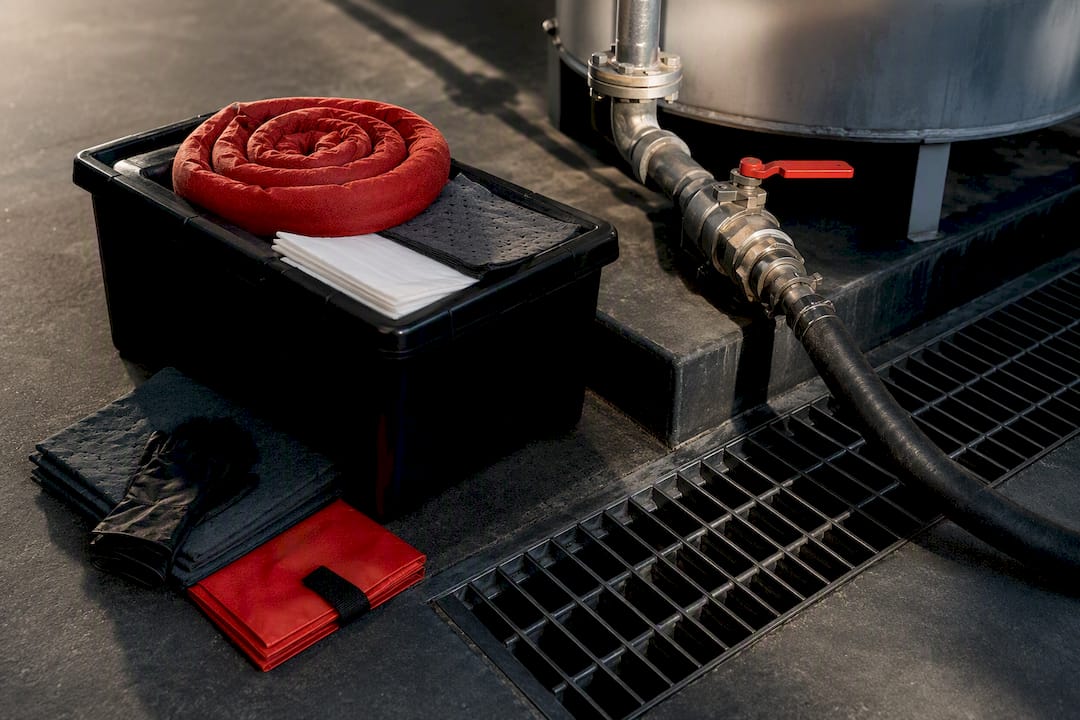
Documentation matters just as much as hardware. Keep delivery tickets, tank inspection records, and any required environmental permits on file and organized by date. Inspectors and insurers alike will ask for a paper trail first, and a site that takes small, frequent deliveries needs a tighter record-keeping habit than one that gets a single large lift every few months. Train whoever receives the delivery, not just facilities managers, on shutoff procedures and who to call if a hose connection fails mid-transfer. The person standing next to the truck during offload is your actual first line of defense, regardless of how small the order was.
Does Fuel Type Change Your Minimum Delivery Quantity?
Fuel specification affects minimums more than most buyers expect. Dyed off-road diesel and clear on-road diesel are chemically similar but carry separate documentation, storage, and sometimes tax requirements, and a supplier juggling both may set a higher minimum for whichever fuel type is less common on their regular route.
Seasonal blending adds another wrinkle. Diesel sold in colder months typically shifts to a winterized blend to resist gelling, and suppliers sometimes tighten minimums during that transition window simply because switching tank compartments between summer and winter blends adds handling time. If your site orders right at a seasonal changeover, expect slightly less flexibility on small-order requests than you’d get in the middle of a stable season.

Additive requirements can push minimums up too. If your equipment specifications call for a particular cetane rating, biodiesel blend percentage, or a specific corrosion inhibitor package, the supplier may need to run a dedicated batch or compartment for your order. Dedicated batches are rarely economical below a certain volume, so specialty fuel requests often carry a higher minimum than standard No. 2 diesel. DEF (diesel exhaust fluid) is its own category entirely. It has separate purity standards and packaging, and minimums for DEF delivery are typically set independently from your diesel order rather than bundled into the same threshold.
If your equipment runs on standard clear diesel with no special additive package, you have the most negotiating room on minimums. Specialty fuel or blend requirements narrow that room considerably.
Do Small Fuel Deliveries Have a Bigger Environmental Footprint?
Frequent small deliveries generally produce more delivery-truck emissions per gallon than infrequent large lifts, because the truck’s engine, idling time, and mileage are spread across less fuel per stop. A site that takes five 200-gallon drops a month is running the same truck route five times instead of once, and that repetition adds up in fuel burned just to get the truck there.
Consolidating orders, whether through tank rental, multi-site scheduling, or simply raising your order size closer to the supplier’s preferred minimum, cuts the number of truck trips your operation generates over a year. That is one of the more overlooked reasons operations teams push toward the higher end of a supplier’s minimum range rather than the lowest volume that technically qualifies.
Fuel degradation is the other environmental and operational concern tied to delivery sizing. Diesel stored for extended periods can develop microbial growth, water contamination, or oxidation, especially in humid climates or tanks with poor housekeeping. A site that orders too far below its actual consumption rate to avoid a larger minimum sometimes ends up holding fuel longer than it should, which raises degradation risk rather than lowering it. The better strategy is usually matching order size to a realistic days-of-coverage target, then rotating stock on a predictable schedule, rather than minimizing every single order out of caution.
How Anytime Fuel Pros Handles Minimums and Uptime
Every option above, tank rental, order consolidation, load-sharing, negotiated volume commitments, comes down to one goal: getting fuel on-site without paying a premium you didn’t need to pay or risking downtime you couldn’t afford. That is the exact problem Anytimefuelpros is built around.
Anytimefuelpros runs scheduled recurring deliveries so you never have to negotiate a fresh minimum every single time you order, along with bulk tank fills for larger sites and tank rental options for teams whose volume doesn’t yet justify a full tanker lift. Multi-site enterprises get a single point of contact through the nationwide partner network, which matters if you are coordinating fuel across a data center in one state and a job site in another. Because emergency response runs 24/7 with transparent invoicing on every ticket, you know exactly what you’re paying and when the truck will show up, whether that’s a scheduled top-off or a middle-of-the-night generator emergency.
If you’re managing a mission-critical site, a remote job location, or a seasonal event that needs generator fuel within a tight window, Anytime Fuel Pros’ diesel delivery service is built for exactly that kind of variability. Ready to see what a delivery schedule tailored to your actual consumption looks like? Request a quote or place an order now and get a straight answer on minimums, lead time, and pricing before fuel ever becomes an emergency.
Sources
This article draws on delivery minimum data from Optimum Fuel Services, tanker capacity figures from Monster Logistics, reorder-point guidance from Gos Energy, and calculation methodology from ShunFuel. For AFP-specific ordering details, see the Fuel Delivery Questions page.
- Diesel fuel delivery FAQ for Optimum Fuel Services
- How bulk liquid transport works: equipment & rates | Monster Logistics
- What fleet managers should know about bulk fuel delivery | Gos Energy
- Mastering bulk fuel calculations: a step-by-step guide for accurate results | ShunFuel
FAQ
What Is the Smallest Fuel Delivery a Supplier Will Do?
Some suppliers will drop as little as 25 gallons depending on schedule and route, though most prefer commercial orders of 100 gallons or more and charge a higher per-gallon rate below that threshold.
How Many Gallons Does a Full Tanker Truck Deliver?
A full tanker lift typically carries 4,000 to 6,500 gallons, depending on the tank’s DOT specification and legal weight limits on the delivery route.
How Do I Calculate My Site’s Reorder Point?
Multiply your average daily fuel usage by your supplier’s lead time in days, then add a safety buffer; that figure is your reorder trigger, and your order size should cover your target days of coverage beyond that point.
Can I Get Fuel Delivered Below My Supplier’s Minimum?
Yes, but usually at a higher per-gallon cost or a short-drop fee, since some providers price small orders differently than standard drops to cover the fixed cost of dispatching a truck.
Does Dyed Diesel Have a Different Minimum Than Clear Diesel?
Not always, but suppliers sometimes set different minimums for dyed off-road diesel versus clear on-road diesel because of separate documentation and compartment-handling requirements.
Recent Comments