
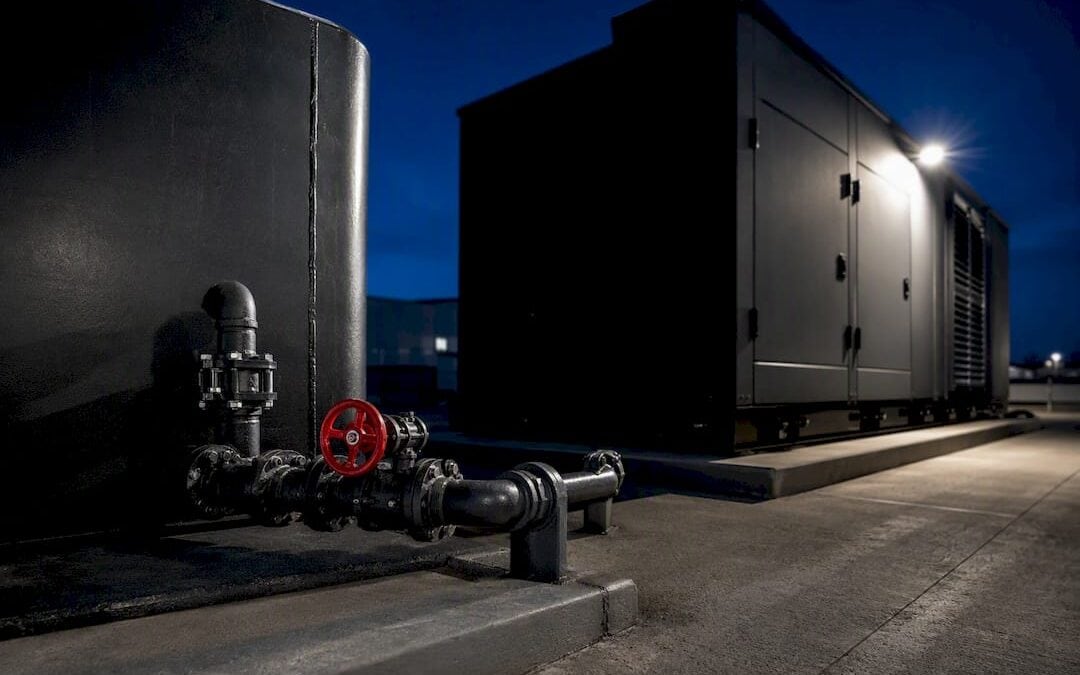
Hospitals must demonstrate a practicable, testable plan to sustain essential electrical systems for up to 96 hours when the grid fails. Meeting that bar comes down to two proven approaches: sufficient onsite diesel storage backed by validated vendor resupply agreements, or reliable natural gas paired with documented utility redundancy and a fallback fuel source. NFPA 110 sets the testing and fuel-quality technical requirements behind that expectation, while Joint Commission standard EC.02.05.07 governs the maintenance cadence surveyors check. Everything below walks through the math, the contracts, and the documentation that turn that plan from paperwork into something that survives an actual outage.
TL;DR:
- Hospitals must have validated plans for sustaining emergency power with enough onsite diesel or natural gas, backed by proper resupply agreements and fuel quality testing.
- Fuel burn rates should be based on actual maximum load consumption, multiplied by 96 hours, with margin, and confirmed through detailed documentation and engineering validation.
- Ensuring resupply contracts specify priority delivery, response times, site access, and liability language is critical for reliable fuel supply during regional emergencies.
- Fuel quality management requires annual ASTM testing, fuel polishing when needed, and detailed records to prevent degradation that can cause generator failure.
- Structural surveyor checks focus on current ASTM reports, resupply agreements, documented exercises, and proper maintenance records to ensure compliance and readiness.
Table of Contents
- What the 96-Hour Rule Actually Requires From Your Hospital Generator Fuel Plan
- Diesel, Natural Gas, or Dual Fuel: Choosing the Right Source
- Keeping Stored Diesel Usable: Quality, Testing, and Treatment
- Building a Fuel Supply Strategy That Survives a Regional Emergency
- How to Calculate Burn Rate and Size Your Onsite Storage
- What Surveyors Actually Check During a Fuel Compliance Review
- Running the Building During a Multi-Day Outage
- How Anytime Fuel Pros Supports Hospital Generator Fuel Resilience
- Authoritative Resources and Standards to Bookmark
- Sources
- FAQ
What the 96-Hour Rule Actually Requires From Your Hospital Generator Fuel Plan
The CMS Emergency Preparedness Rule requires Medicare and Medicaid-participating hospitals to maintain an emergency plan covering policies, communications, training, and testing. In practice, the industry treats sustained operation for 96 hours as the planning baseline surveyors expect facilities to demonstrate, even though CMS itself does not spell out a single fixed number for every scenario. That gap between “plan for sustained operations” and a hard 96-hour figure is exactly why NFPA 110 and Joint Commission fill in the technical details.
NFPA 110 is the standard that actually defines how emergency and standby power systems get tested, maintained, and fueled. It covers everything from generator classification to the fuel-quality expectations that show up when a surveyor asks for your maintenance logs, and it’s the document your engineering team should be citing when they explain testing intervals to administration. Joint Commission EC.02.05.07 builds on that framework, setting the maintenance and testing schedule hospitals must follow and document for accreditation.
Surveyors reviewing your hospital generator fuel program typically want to see four things:
- A documented burn-rate calculation tied to your facility’s maximum anticipated electrical load, not the generator’s nameplate rating.
- Signed vendor resupply agreements with priority-delivery language, not just a phone number on file.
- Exercise records showing your resupply plan has actually been tested, ideally with the vendor participating.
- Recent ASTM fuel-quality lab reports proving stored diesel is still usable, not just present.
Miss any one of those four, and the paperwork gap becomes the finding. Peer-reviewed analyses of healthcare infrastructure failures during disasters have tied generator and fuel failures directly to patient evacuations and harm, which is the underlying reason surveyors treat this documentation as more than a compliance formality.
Diesel, Natural Gas, or Dual Fuel: Choosing the Right Source
Diesel remains the default choice for hospital emergency generators because it’s storable, widely available, and doesn’t depend on a live utility connection during the exact moment the grid goes down. That independence is also its liability: stored diesel degrades through water contamination, microbial growth, and oxidation, which means a fuel source that looks compliant on paper can fail a lab test the week you need it most. Cold-weather markets add another wrinkle, since untreated diesel can gel below certain temperatures, requiring winterized blends or cold-flow additives in northern facilities.
Natural gas generators avoid the storage-degradation problem entirely, since fuel arrives continuously through the utility line rather than sitting in a tank. The tradeoff is that natural gas ties your emergency power directly to a single point of failure: the same regional disaster that knocks out the grid can also disrupt gas distribution. ASPR TRACIE guidance specifically calls out that facilities relying on natural gas need documented evidence of utility reliability, or a contingency fuel plan that doesn’t just assume the pipeline stays intact.
Dual-fuel and bi-fuel generators split the difference, running primarily on natural gas with diesel as an automatic backup. That flexibility comes with an approval catch: your fire marshal or authority having jurisdiction (AHJ) will want to review dual-fuel configurations separately, since the switching logic and secondary fuel storage both need sign-off.
Key considerations for your fuel-type decision:
- Diesel gives you storage independence but demands an active fuel-quality management program.
- Natural gas eliminates degradation risk but requires documented utility redundancy.
- Dual-fuel systems add resilience but need AHJ approval for the switching and storage configuration.
- Facilities in disaster-prone regions often benefit from diversifying fuel types rather than betting on one source.
Keeping Stored Diesel Usable: Quality, Testing, and Treatment
Stored diesel doesn’t fail all at once. It degrades gradually through water intrusion (from condensation in partially filled tanks), microbial growth that thrives at the fuel-water interface, and oxidation that forms sludge and varnish over months of sitting unused. Any one of those processes can clog fuel filters and injectors precisely when your generator needs to start under load, which is why fuel-quality management belongs on the same priority tier as generator testing itself.

The industry-standard response is ASTM-based fuel analysis, typically performed annually with more frequent visual or water-bottom checks in between. A full lab panel checks for water content, particulate contamination, microbial presence, and oxidation stability, giving you a documented baseline you can hand to a surveyor without hesitation.
Build your maintenance program around these checkpoints:
- Pull fuel samples from the tank bottom, not just the top, since water and sediment settle first.
- Schedule annual ASTM lab analysis and keep the reports on file for at least three years.
- Use fuel polishing, filtering fuel through a mobile unit to remove water and particulates, when lab results show contamination trending upward.
- Add biocide treatment proactively in humid climates where microbial growth accelerates.
- Check day-tank transfer pumps and tank venting systems during routine generator tests, not as a separate task.
Pro Tip: Treat your fuel-polishing schedule the same way you treat generator load tests. A tank that passed its ASTM report last year can still fail this year if humidity, temperature swings, or a slow leak introduced water since the last sample. Retest, don’t assume.
Documentation matters as much as the maintenance itself. Keep a running file of every lab report, every polishing event, and every biocide application, dated and organized by tank. That record is what turns “we manage our fuel” into a demonstrable, auditable program.
Building a Fuel Supply Strategy That Survives a Regional Emergency
Deciding how much to store onsite versus how much to rely on vendor resupply comes down to a straightforward risk calculation: how long can your facility run on tank volume alone, and what happens if the roads are impassable or every hospital in the region is calling the same supplier at once? Facilities with less than 40 hours of onsite runtime are generally advised to secure a secondary supplier as a matter of course, rather than treating a backup vendor as optional insurance.
A resupply contract is only as good as what it actually specifies. Before signing, insist on these terms:
- Documented delivery priority. Get it in writing that your facility receives priority status during a declared emergency, not a verbal assurance.
- Guaranteed response windows. Specify maximum delivery times for both routine and emergency orders, and hold the vendor to them.
- Site access details on file. Share fill-pipe length, gravity-drop location, and quick-connect points with the vendor before an emergency, not during one.
- Clear payment terms. Some vendors will only deliver against immediate payment during large-scale events, so pre-establish credit or fast-track payment authorization.
- Explicit liability language. Define what happens if the vendor can’t reach your site, and whether that triggers your secondary supplier automatically.
Multiple vendors matter because fuel distribution networks themselves are vulnerable to the same regional disruptions that cause the power outage in the first place. A single contract, no matter how well written, doesn’t help if that one supplier’s trucks are stuck behind the same downed trees your facility is dealing with. FEMA and state guidebooks consistently recommend at least one out-of-region backup supplier for exactly this reason.
Pro Tip: A signed contract is not the same as a deliverable fuel order. Confirm your vendor has your facility’s fill-pipe diameter, access road width, and quick-connect location on file right now, not the day a hurricane warning goes up.
How to Calculate Burn Rate and Size Your Onsite Storage
Sizing your tank correctly starts with a number most facilities get wrong: burn rate at maximum anticipated load, not the generator’s nameplate capacity. Nameplate ratings assume full theoretical output, which your hospital rarely draws in practice, so basing your calculation on that figure either wildly overstates your fuel need or, worse, understates it if your actual critical load during an extended outage runs higher than expected.
Follow this sequence to build a defensible calculation:
- Measure actual gallons-per-hour consumption at your realistic maximum load, using generator run data from load-bank testing or historical fuel logs rather than manufacturer specs alone.
- Multiply that hourly rate by 96 hours to establish your baseline fuel requirement for the full sustainment window.
- Add a defensible margin, typically 10 to 20 percent, to account for colder starts, higher-than-expected load, or minor resupply delays.
- Convert the total into usable tank capacity, accounting for the fact that tanks can’t be drawn down to zero without risking pump cavitation or fuel-quality issues at the tank bottom.
- Set a reorder threshold, commonly triggering resupply orders once usable volume drops to 50 percent, so you’re never running the calculation for the first time during an actual event.
- Have the final numbers validated by a mechanical engineer or your fuel vendor before submitting them as your official compliance figure.
Document every step of that math. When a surveyor asks how you arrived at your tank size, “we did the calculation and had it checked” is a far stronger answer than a number pulled from a spec sheet.
What Surveyors Actually Check During a Fuel Compliance Review
Joint Commission and NFPA-aligned inspections follow a predictable rhythm, and knowing that rhythm ahead of time takes most of the guesswork out of survey prep. Generators typically require a monthly exercise under load along with an annual full-load test, and both need dated, signed records showing duration, load percentage, and any faults observed. Battery checks, transfer switch operation, and alarm functions usually get folded into that same monthly cycle.
On the fuel side, surveyors expect to see:
- ASTM lab reports from the last testing cycle, filed and dated by tank.
- Records of any fuel-polishing or biocide treatment performed in response to test results.
- Vendor resupply agreements with priority language and delivery-time commitments.
- Documentation showing a tabletop or full-scale exercise that actually tested the resupply plan, ideally with the vendor’s participation logged.
Pennsylvania’s healthcare fuel shortage guidebook and similar state playbooks recommend running these exercises annually at minimum, with vendors and local emergency management included as active participants rather than passive contacts. The most common survey finding isn’t a broken generator. It’s a missing or outdated record, a contract that expired without renewal, or a burn-rate calculation nobody can explain. Fix the paperwork trail first, and the mechanical side usually follows.
Running the Building During a Multi-Day Outage
The first hour after a grid failure sets the tone for the next four days. Verify the automatic transfer switch engaged correctly, check tank levels against your calculated burn rate, and open communication with your fuel vendors immediately, before you actually need a delivery.
- Confirm ATS function and record the exact time power transferred to generator.
- Check current fuel levels against your documented burn-rate math to project remaining runtime.
- Contact primary and secondary vendors to confirm delivery windows before your tank drops below the reorder threshold.
- Activate load shedding in a predetermined order: life-safety and critical care systems stay fully powered, while non-essential loads like decorative lighting or non-critical HVAC zones get cut first.
- Stage delivery trucks to avoid congestion at the fill point, and confirm site access with security ahead of arrival.
- Post security at fuel storage areas and log every delivery and draw-down to prevent theft and maintain an accurate inventory count.
That load-shedding hierarchy should already be written down and rehearsed. An outage is the wrong time to debate which systems matter most.
How Anytime Fuel Pros Supports Hospital Generator Fuel Resilience
The compliance work above is only as good as the fuel that actually shows up on delivery day. Fuel delivery vendors provide on-site diesel delivery, scheduled top-offs to keep tanks above reorder thresholds, and emergency response for regional outages affecting hospitals.
For hospital facility teams building or renewing a resupply contract, AFP’s generator fuel delivery and emergency fuel delivery services line up directly with the priority-access and fast-response language surveyors want documented. Fuel polishing is available for facilities whose ASTM reports show contamination trending the wrong way, addressing degraded diesel before it becomes a starting failure. When negotiating terms, ask AFP directly about response-time commitments, reporting formats for your compliance file, and how site access details like fill-pipe location and quick-connect points get logged ahead of time. Some fuel delivery providers serve major Texas and Utah metro areas, with nationwide coverage available through partner networks for multi-site health systems. If your facility’s current fuel plan has gaps in delivery priority, response time, or documentation support, request a fuel services quote and get those terms in writing before the next outage tests them for you.
Authoritative Resources and Standards to Bookmark
Keep these on hand: NFPA 110 for testing and fuel-quality technical requirements, Joint Commission standards for the 96-hour planning baseline and maintenance cadence, ASPR TRACIE’s fuel tip sheet for burn-rate and vendor-redundancy guidance, and FEMA’s preparedness library for exercise templates and fuel-shortage contingency planning.
Sources
- Los Angeles County EMS Agency — Emergency Power Resilience Playbook
- ASPR TRACIE — Utility failures in health care tip sheet: Natural gas/Fuel
- NFPA — An overview of NFPA 110
- The Joint Commission — Standards (reference to EC.02.05.07)
- FEMA — Preparedness documents
FAQ
What Are the Fuel Requirements for a Hospital Emergency Generator?
Hospitals need enough onsite fuel, or a validated resupply plan, to sustain essential electrical systems for the 96-hour planning baseline referenced by Joint Commission and CMS. Fuel quality also matters: stored diesel needs periodic ASTM testing to confirm it hasn’t degraded past usability.
What Generators Do Hospitals Use?
Most U.S. hospitals run diesel-fueled standby generators built to NFPA 110 standards, chosen for their ability to store fuel independently of utility service. A growing number use natural gas or dual-fuel systems, provided the facility documents utility reliability or maintains a diesel backup as required by the local fire marshal or AHJ.
How Long Can a Hospital Backup Generator Run?
Runtime depends entirely on onsite tank capacity and actual burn rate at maximum anticipated load, not generator specifications alone. Facilities calculate this by multiplying measured gallons-per-hour consumption by 96 hours, then adding a margin, which is the standard method for sizing storage to the accepted planning window.
What Type of Fuel May Be Used in an Emergency Generator?
Diesel is the most common fuel for hospital emergency generators because it stores independently of utility infrastructure, but natural gas and dual-fuel configurations are also acceptable when documented properly. Any fuel choice requires evidence, whether that’s ASTM fuel-quality reports for stored diesel or utility-reliability documentation for natural gas systems.
Does Anytime Fuel Pros Deliver Fuel Directly to Hospital Generators?
Yes, Anytime Fuel Pros provides on-site generator fuel delivery including scheduled top-offs and emergency response for hospitals in its Texas and Utah service areas, with nationwide coverage through its partner network. Pricing is not published; facilities should request a quote directly for current rates and contract terms.
Recent Comments