

A fuel delivery service level is a supplier’s explicit, contractual commitment to deliver fuel on time, in the correct quantity, and according to agreed operational standards that keep your business running without interruption. The industry term for this commitment is a Service Level Agreement, or SLA, and it forms the legal and operational backbone of every serious fuel supply contract. Facilities managers and procurement officers at data centers, construction sites, mining operations, and municipal fleets depend on these commitments to protect uptime and control costs. Without a clearly defined fuel delivery service level, you are operating on a supplier’s goodwill rather than an enforceable obligation. Understanding what these agreements contain, how delivery models differ, and how to negotiate terms that match your operational risk profile is the difference between a reliable fuel supply and a costly disruption.
What does a fuel delivery service level typically include?
A fuel delivery service level describes the supplier’s contracted performance commitments covering delivery timing, reliability, and operational steps such as metered transfer and documentation. These commitments translate into specific, measurable obligations that both parties can verify and enforce. The core components fall into four categories.
Delivery timing and windows define exactly when fuel arrives. This includes scheduled delivery windows for recurring needs, on-demand response times for flexible requests, and emergency response times for unplanned refueling events. A data center SLA, for example, might specify a four-hour emergency response window for generator top-offs during a grid outage.

Reliability and availability commitments set the supplier’s performance floor. These clauses specify minimum fill rates, acceptable delivery variance, and what constitutes a missed delivery. Suppliers with strong operational infrastructure back these commitments with historical performance data.
Operational protocols cover the mechanics of each delivery: metered transfer to verify volume, delivery receipts and sign-off procedures, driver certification requirements, and spill prevention compliance. These protocols matter for logistics yard operations where documentation feeds into fleet cost accounting and regulatory reporting.
Legal remedies for non-performance define what happens when the supplier misses a commitment. Fuel supply agreements commonly set delivery schedules as “time requirements of the essence,” meaning a missed window constitutes a material default with enforceable legal remedies. This language is not standard boilerplate. You must negotiate it into the contract explicitly.
- Scheduled delivery windows with confirmed lead times
- On-demand and emergency response time commitments
- Metered transfer and volume verification protocols
- Delivery documentation and sign-off requirements
- Default definitions and remedy clauses for missed deliveries
- Force majeure exclusions that limit supplier liability
Pro Tip: Request a sample SLA from any prospective supplier before signing. If they cannot produce one, treat that as a red flag. A supplier without a documented service level framework is a liability for mission-critical operations.
How do scheduled, on-demand, and emergency delivery models compare?
Mobile fuel delivery services operate through three primary models: scheduled, on-demand, and emergency. Each model carries different cost structures, reliability profiles, and use cases. Choosing the wrong model for your operational profile creates either unnecessary cost or unacceptable risk.
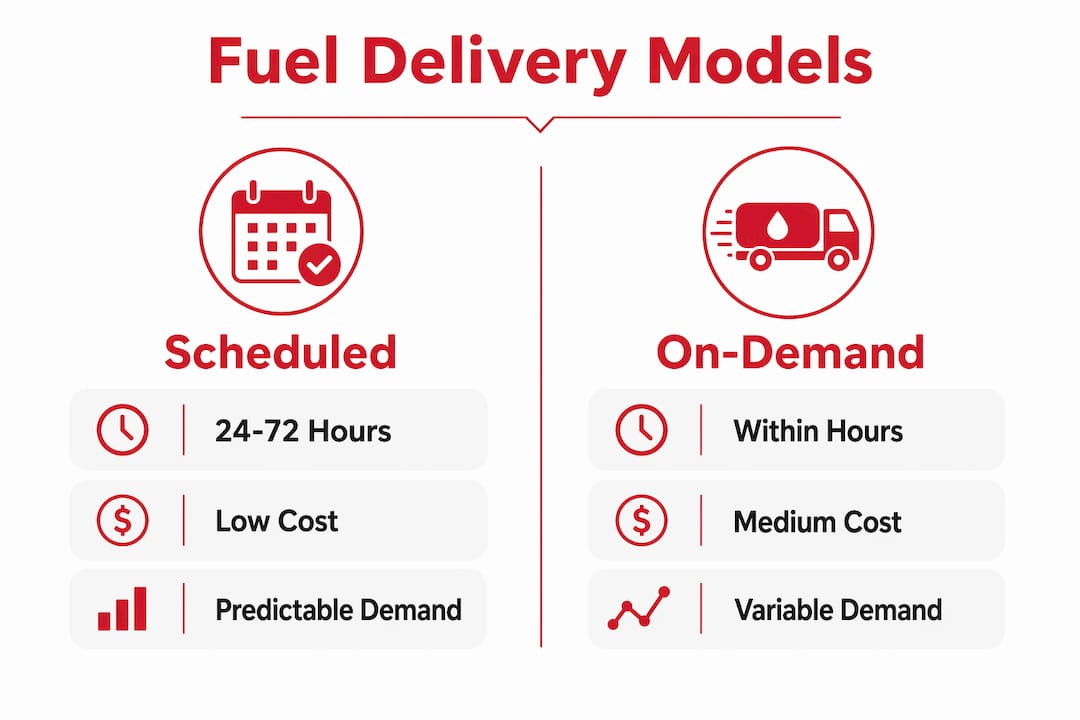
Scheduled delivery is the baseline model for operations with predictable, recurring fuel demand. A construction site running three excavators and two generators on a fixed schedule knows its daily diesel consumption within a narrow range. Scheduled deliveries arrive on a set cadence, often weekly or bi-weekly, and are priced at the lowest rate because the supplier can plan logistics efficiently. The limitation is inflexibility. If consumption spikes unexpectedly, a scheduled-only contract leaves you short.
On-demand delivery serves operations with variable fuel needs. A municipal fleet that runs heavier during storm response or a mining site ramping up production mid-quarter benefits from on-demand access. Response times are longer than emergency service, typically measured in hours rather than minutes, and pricing reflects the added logistics complexity. The benefits of fuel delivery on-demand include eliminating crew trips to retail stations and reducing the risk of running equipment dry during unexpected demand surges.
Emergency delivery is the highest-cost, fastest-response model. Data centers, hospitals, and telecom infrastructure operators use emergency fuel delivery as a backstop when backup generators activate during grid failures. Response windows in well-structured SLAs run two to four hours, and pricing typically carries a premium over standard rates.
| Delivery model | Typical response time | Relative cost | Best use case |
|---|---|---|---|
| Scheduled | 24 to 72 hours advance notice | Lowest | Predictable recurring demand at construction, mining, or fleet sites |
| On-demand | 2 to 8 hours | Moderate | Variable demand, municipal fleets, event fueling |
| Emergency | Under 4 hours | Highest | Mission-critical uptime, data centers, disaster response |
Most facilities managers running complex operations benefit from a hybrid contract that combines a scheduled base delivery with on-demand and emergency provisions. This structure controls costs on predictable volume while protecting against the scenarios that cause the most operational damage.
Why SLAs are critical in fuel delivery contracts
A fuel delivery SLA is not a summary of the supplier’s marketing promises. It is an enforceable legal document that specifies performance metrics, defines default conditions, and assigns consequences for non-performance. The distinction matters because vague commitments protect the supplier, not you.
Fuel supply agreements specify terms including pricing models, delivery schedules, quality standards, duration, and risk allocation to ensure a steady, predictable fuel supply. Effective SLAs go further by separating supply and logistics timing obligations from the contractual remedies triggered when those obligations are missed. This separation is what makes an SLA enforceable rather than aspirational.
The most important clause in any fuel delivery SLA is the default and remedy provision. Failure to deliver fuel as agreed often results in material breach, which is why contractual SLA terms must be clear, measurable, and enforceable. Force majeure exceptions typically exclude supplier defaults unrelated to genuinely uncontrollable events, meaning a supplier cannot invoke weather as an excuse for a missed delivery caused by poor logistics planning.
“Strong service level negotiations separate commitments into supply and logistics timing and contractual remedies for missed deliveries, not relying on vague marketing promises.”
For mission-critical operations, enterprise fuel delivery contracts benefit from splitting service-level terms into timing obligations and liquidated damages or remediation clauses to handle missed delivery windows. Liquidated damages clauses specify a pre-agreed financial penalty for each missed window, which creates a direct financial incentive for the supplier to perform. This structure is standard in utility and data center contracts and should be standard in your fuel supply agreement as well.
Pro Tip: Include a “time of the essence” clause for every delivery window in your SLA. This single phrase transforms a delivery schedule from a guideline into a legally binding obligation, and it is the most cost-effective protection you can negotiate into a fuel supply contract.
How to evaluate and select a fuel delivery service
Selecting a fuel delivery provider is a procurement decision with direct operational consequences. The evaluation process should be structured, not reactive. Facilities managers evaluate service levels by reviewing delivery schedules, reliability data, operational protocols, and contractual language to match supplier capability to mission-critical fuel needs.
Use this numbered framework to structure your evaluation:
-
Map your fuel demand profile. Document your average daily consumption, peak demand periods, and the consequences of a fuel-out event at each site. A data center generator running dry during a grid failure has a different cost profile than a construction site running low on a Friday afternoon.
-
Request documented SLA terms before any commercial discussion. A supplier who cannot produce a written SLA with specific timing commitments, default definitions, and remedy clauses is not operating at the service level your operations require.
-
Verify operational protocols. Ask specifically about metered transfer procedures, delivery documentation, driver certification, and spill response protocols. Bulk fuel delivery is an ongoing partnership involving safety compliance, logistics, and timely delivery. Suppliers who treat these as administrative details rather than operational commitments introduce compliance and liability risk.
-
Assess emergency response capability. Ask for documented response times and request references from clients who have activated emergency delivery. A supplier’s emergency response record is the most honest indicator of their operational reliability.
-
Evaluate pricing models in relation to service levels. Fuel delivery pricing models typically include spot pricing tied to daily rack rates, fixed-price contracts for budget certainty, and index-based pricing that tracks market benchmarks. Understand which model applies to each delivery type in your contract, and confirm that emergency delivery pricing is capped or pre-agreed rather than open-ended.
-
Negotiate SLA terms, not just price. Price is visible and easy to compare. Service level terms determine whether your operations stay running when conditions are difficult. Procurement officers who focus exclusively on per-gallon cost and ignore SLA language consistently underestimate the total cost of a supplier failure.
-
Confirm coverage for all your sites. Multi-site operations need a supplier with either direct coverage or a verified partner network across all locations. Managing separate regional vendors for each site creates coordination gaps that surface at the worst possible moments.
Pro Tip: Ask every prospective supplier for their on-time delivery rate over the past 12 months. Reliable providers track this metric and share it willingly. Providers who cannot answer the question are telling you something important about their operational discipline.
Key takeaways
A fuel delivery service level is only as strong as the SLA language that defines it. Vague commitments protect the supplier; specific, measurable, and enforceable terms protect your operations.
| Point | Details |
|---|---|
| Service level definition | A fuel delivery service level is a supplier’s contractual commitment covering timing, reliability, and operational protocols. |
| SLA as legal backbone | SLAs must include “time of the essence” language, default definitions, and remedy clauses to be enforceable. |
| Delivery model selection | Match your delivery model (scheduled, on-demand, or emergency) to your operational risk profile and demand variability. |
| Evaluation criteria | Assess suppliers on documented SLA terms, emergency response history, operational protocols, and multi-site coverage. |
| Pricing and service alignment | Understand how pricing models apply to each delivery type, and pre-agree emergency delivery rates to avoid cost surprises. |
How Anytimefuelpros delivers on service level commitments
Anytimefuelpros structures every fuel delivery contract around transparent service levels, not marketing language. Whether you need scheduled diesel delivery for a construction fleet in Dallas, recurring generator top-offs for a data center in Salt Lake City, or emergency fuel response for mission-critical infrastructure anywhere in the continental United States, Anytimefuelpros backs its commitments with documented SLA terms, 24/7 emergency response, and transparent invoicing.
Anytimefuelpros serves data centers, mining operations, municipal fleets, construction sites, and large-scale events across Texas, Utah, and nationwide through a verified partner network. If you are evaluating fuel delivery options for a multi-site operation or need to upgrade your current SLA terms, visit the fuel delivery FAQ or contact the team directly to discuss a contract structure that matches your operational requirements.
FAQ
What is a fuel delivery service level?
A fuel delivery service level is a supplier’s contracted commitment specifying when fuel will be delivered, in what quantity, and according to what operational standards. It is formalized in a Service Level Agreement and is the primary mechanism for holding a supplier accountable to performance obligations.
What should a fuel delivery service agreement include?
A fuel delivery service agreement should include delivery schedules, on-demand and emergency response times, pricing models, quality standards, metered transfer protocols, default definitions, and remedy clauses for missed deliveries. “Time of the essence” language makes delivery timing legally enforceable.
How does emergency fuel delivery work?
Emergency fuel delivery is an unplanned, rapid-response service activated when a site runs critically low on fuel outside of scheduled windows. Licensed crews deliver diesel or gasoline on-site, typically within two to four hours under a well-structured SLA, to restore operations without downtime.
What is the difference between scheduled and on-demand fuel delivery?
Scheduled delivery operates on a fixed recurring cadence at the lowest cost, suited for operations with predictable consumption. On-demand delivery responds to variable or unplanned needs within hours, at a moderate premium, and is better suited for fleets or sites with fluctuating fuel demand.
Why do SLAs matter more than price in fuel delivery contracts?
SLA terms determine whether your operations stay running when a supplier faces logistics pressure or high demand. A low per-gallon price from a supplier with weak or unenforceable SLA language creates more total cost risk than a slightly higher price from a supplier with documented, measurable performance commitments.
Recent Comments